Zur Produktinfo springen
1 of 2

GN Labaratories

GN Sulforaphane Broccoli Extract 60 Capsules

Regulärer Preis
$52.90 USD
Regulärer Preis
Angebotspreis
$52.90 USD
Inkl. MwSt. Shipping wird beim Checkout berechnet.

Weitere Ausführungen:

Highlights

GN Laboratories' Sulforaphane Broccoli Extract is a high-quality dietary supplement that delivers the health benefits of broccoli in convenient capsule form.

  • Contents: 60 capsules per pack
  • Main ingredient: Sulforaphane, a powerful antioxidant
  • Supports detoxification of the body
  • Promotes immune system health
  • May have anti-inflammatory properties
  • Suitable for vegetarians and vegans
Recommended intake

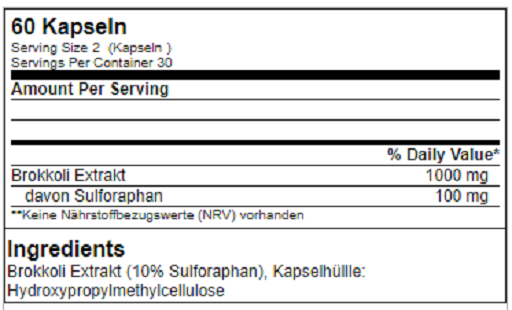
The recommended serving size and daily intake for GN Sulforaphane Broccoli Extract 60 capsules is 2 capsules per day. Please also refer to the information on the packaging, as the manufacturer may occasionally change the composition!

Warning notices

The recommended daily intake must not be exceeded.

Food supplements should not be used as a substitute for a balanced and varied diet and a healthy lifestyle.

Keep out of reach of small children. Store in a cool, dry place away from light.

We are happy to answer any further questions about ingredients or product-related inquiries in our chat.

Nutritional information
Nährwerte Je 100g/ml
Brennwert 0 kJ / 0 kcal
Fett 0 g
Kohlenhydrate 0 g
— davon Zucker —
Eiweiß 0 g
Salz
Manufacturer's specifications

Gigas Nutrition BV, Postbus 111, 5900AC, Venlo Netherlands, info@gnlaboratories.com

    GN Sulforaphane Broccoli Extract 60 Capsules
    Gn Sulforaphane Broccoli Extract 60 Capsules
    Gn Sulforaphane Broccoli Extract 60 Capsules

    GN Sulforaphane Broccoli Extract 60 Capsules in detail

    Questions about GN Sulforaphane Broccoli Extract 60 Capsules

    What is the difference between the sulforaphane contained in GN Sulforaphane Broccoli Extract and its precursor glucoraphanin?

    Glucoraphanin is the inactive precursor of sulforaphane and belongs to the glucosinolates, which occur naturally in cruciferous vegetables such as broccoli. Sulforaphane, on the other hand, is the biologically active form, produced when glucoraphanin comes into contact with the enzyme myrosinase.
    Here are the main differences and how they might relate to the product GN Sulforaphane Broccoli Extract 60 Capsules:
    Glucoraphanin:
    * Precursor: Glucoraphanin is a glucosinolate and the inactive form found in intact plant cells (or their seeds).
    * Conversion: The conversion to sulforaphane occurs when plant cells are damaged, for example, by cutting, chewing, or crushing. During this process, glucoraphanin interacts with the enzyme myrosinase. This conversion can also occur in the gastrointestinal tract through the gut microbiota, even if plant myrosinase is not present.
    * Stability: Glucoraphanin is a biologically stable precursor.
    * Occurrence: It is particularly abundant in broccoli sprouts and broccoli seeds.
    Sulforaphane:
    * Active form: Sulforaphane is the bioactive isothiocyanate responsible for the health benefits.
    * Mechanism of action: It acts as a potent indirect antioxidant by activating phase II enzymes, thereby strengthening the body's antioxidant defense mechanisms. It may also have anti-inflammatory and antimicrobial effects.
    * Health benefits: Sulforaphane is associated with various health benefits, including supporting the body's detoxification processes, cellular health, and the immune system. It is also being studied for potential anti-cancer properties.
    * Stability: Sulforaphane is a rather unstable compound.
    * Regarding GN Sulforaphane Broccoli Extract 60 Capsules:
    Since the product is called "GN Sulforaphane Broccoli Extract," this indicates that it aims to provide sulforaphane in its active form or an optimized form for sulforaphane production. Some products contain glucoraphanin along with myrosinase to ensure conversion in the body. Other products stabilize the sulforaphane directly in the extract.
    It is important to note that the bioavailability of sulforaphane can vary significantly depending on how it is ingested. Raw broccoli or broccoli sprouts tend to have higher sulforaphane levels because cooking can destroy the enzyme myrosinase. Supplements containing glucoraphanin may have comparable sulforaphane bioavailability to broccoli sprouts, especially when combined with myrosinase.
    To obtain precise information about the specific product "GN Sulforaphane Broccoli Extract 60 Capsules," the ingredients should be checked on the product packaging or in the product description. It should state whether it contains glucoraphanin, sulforaphane, or a combination thereof, and whether myrosinase is included.

    What is the recommended daily intake of sulforaphane for preventative purposes, and how can this dosage be individually adjusted to one's own body weight?

    There is no officially established Recommended Daily Allowance (RDA) for sulforaphane by government health authorities. Scientific literature and naturopathy often recommend dosages between 10 mg and 60 mg of sulforaphane per day for preventative purposes.
    The product GN Sulforaphane Broccoli Extract contains 500 mg of broccoli extract per capsule, standardized to 10% sulforaphane. This corresponds to an active ingredient amount of 50 mg of sulforaphane per capsule. The manufacturer's recommended intake is one capsule daily, which fully covers the range for preventative dosing.
    To adjust the dosage to individual body weight, experts often use a guideline of approximately 0.3 mg to 0.5 mg of sulforaphane per kilogram of body weight. For a person weighing 70 kg, this would result in a calculated amount of approximately 21 mg to 35 mg per day. Since GN Labs' capsules contain a higher dose of 50 mg sulforaphane, one capsule daily is sufficient even for heavier individuals to achieve the desired preventative blood level. More precise subdivision below one capsule is not possible due to the powder capsule formulation.

    What role does the transcription factor Nrf2 play in the sulforaphane-induced activation of endogenous antioxidant enzymes and detoxification in the liver?

    The transcription factor Nrf2 plays a key role in the effects of sulforaphane from GN Sulforaphane Broccoli Extract, as it acts as a major regulator of the cellular stress response. Under normal conditions, Nrf2 is bound and degraded in the cytoplasm by the protein Keap1. However, the supply of sulforaphane releases this binding, allowing Nrf2 to stabilize and migrate into the cell nucleus. There, the factor binds to the so-called antioxidant response element in DNA and initiates the transcription of numerous genes responsible for the production of endogenous antioxidant enzymes such as superoxide dismutase and glutathione peroxidase, as well as phase II detoxification enzymes. In the liver, this process leads to a significant increase in detoxification capacity, as potentially harmful substances are neutralized and made water-soluble more efficiently, while at the same time, protection against oxidative stress is sustainably improved through the increased production of protective proteins.

    What are the known interactions between taking sulforaphane and the effectiveness of certain medications, such as cytostatics or lipid-lowering drugs?

    Sulforaphane can interact with medications metabolized by the liver (particularly the enzyme CYP3A4). Sulforaphane can inhibit this enzyme, potentially increasing the effects and risk of side effects of medications such as lipid-lowering drugs (e.g., simvastatin) or immunosuppressants (e.g., cyclosporine). Regarding cytostatic drugs, studies suggest that sulforaphane may enhance the efficacy of certain chemotherapeutic agents (e.g., PR-104A), potentially allowing for lower doses. Due to these effects on drug metabolism, the use of sulforaphane extracts in conjunction with other medications should be discussed with a physician beforehand.

    Fast shipping from Bielefeld
    14-day right of withdrawal
    10% off your first order with the code: FIRST10